City of Surrey Economic Strategy
Project scope
Surrey is entering a pivotal period of growth and economic transformation. The City is on a trajectory toward one million residents, creating an estimated need for roughly 300,000 additional jobs by 2042.
The Economic Strategy had to address more than conventional business attraction and economic development. Surrey faced a city-building challenge: how to ensure extraordinary population growth was matched by equally ambitious job creation and economic development. The strategy needed to identify how the City could leverage its scale, strategic location, employment lands, diverse talent base, emerging innovation assets, and other advantages to build a stronger, more complete metropolitan economy – all in less than 20 years.
The project involved developing the structure, logic, and narrative that would turn extensive research and stakeholder input into a clear roadmap for action.
Core challenges
The City had extensive economic analysis, consultation findings, previous strategies, departmental knowledge, and evidence of progress under the existing strategy. The challenge was to turn all of that material into one coherent strategic argument that could credibly support the ambitious vision of creating 300,000 additional jobs by 2042.
This required the strategy to:
Build a distinctive investment proposition for Surrey by identifying the assets and competitive advantages that could genuinely differentiate the city from competing jurisdictions, and translating them into a clear case for why businesses and investors should choose Surrey.
Create a clear strategic architecture by organizing a large number of priorities, initiatives, opportunities, and existing programs into distinct pillars with a logical relationship between objectives, strategic directions, and actions.
Be extremely ambitious and credible. The strategy had to be bold enough to match Surrey’s extraordinary growth trajectory while remaining grounded in the City’s current capabilities, resources, influence, and realistic ability to deliver.
Respond to a rapidly changing global environment, including shifting trade patterns, geopolitical risk, supply-chain disruption, changing federal and provincial priorities, and growing competition for investment. The strategy therefore had to improve Surrey’s investment readiness in the near term while strengthening its economic resilience over the longer term.
Make better use of its finite industrial land base, identifying how employment lands could support higher-value economic activity, attract the right kind of investment, and generate more jobs.
Connect actions to outcomes without overstating municipal control. With a goal as ambitious as 300,000 additional jobs, the strategy needed a defensible line of sight between what the City could actually do (e.g., land use, infrastructure, investment attraction, partnerships, policy, advocacy) and the broader economic outcomes it needed to influence.
Integrate economic development with the City’s wider strategic agenda, connecting economic priorities to Surrey’s goals for livability, climate action, transportation, land use, and sustainable growth so that economic development reinforced other city-building objectives.
The core challenge was to build a strategy ambitious enough for Surrey’s growth trajectory, but grounded enough in the City’s actual assets, capabilities, and levers to remain credible and actionable. That meant turning a vast body of information into a coherent strategic logic linking priorities, actions, and outcomes, and then shaping it into a narrative the business community and broader public could understand and support.
Approach
The work combined strategic analysis, synthesis, facilitation, framework development and writing. A central part of the approach was creating structured tools and working sessions that helped the Economic Development team organize a vast body of information, test strategic choices, and build a credible logic between Surrey’s advantages, priorities, actions, and desired outcomes.
Writing then became part of the strategy-development process itself – not simply the final step. Drafting was used to test assumptions, expose gaps, sharpen choices, and translate the emerging strategic logic into a compelling public-facing narrative.
The approach included:
Creating a decision-making framework for the strategy itself. I designed a comprehensive Action Planning Workbook and facilitated a structured workshop with the Economic Development team to test every proposed pillar against its challenges, opportunities, objectives, actions, and intended outcomes. The process helped the team make difficult choices, identify gaps, sharpen priorities, and establish a credible logic from action to outcome – providing much of the foundation for the strategy’s final structure and narrative.
Assessing and synthesizing the evidence base, including the previous Economic Strategy, progress to date, economic research, consultation findings, City plans, departmental knowledge, and emerging global trends.
Identifying Surrey’s strongest competitive advantages and strategic opportunities, and translating them into a clearer value proposition for businesses, investors, and talent.
Developing and testing the strategic architecture, organizing priorities into distinct pillars and ensuring the relationship between objectives, directions, actions, and outcomes was ambitious but credible given the City’s actual capabilities and levers.
Integrating economic priorities with broader city-building goals, including livability, climate, transportation, land use, investment readiness, resilience, and long-term sustainable growth.
Building and refining the public-facing narrative, working iteratively with Economic Development staff to challenge assumptions, build alignment, and translate complex strategic logic into a clear and compelling story for businesses, partners, decision-makers, and the broader public.
The process did more than organize information. It helped turn evidence into choices, choices into a coherent strategic framework, and that framework into a credible public narrative – giving the final strategy a clear logic from Surrey’s competitive advantages and priorities through to action and intended outcomes.
Outcome
The resulting strategy won the British Columbia Economic Development Association (BCEDA) award in the Economic Recovery and Resiliency category.
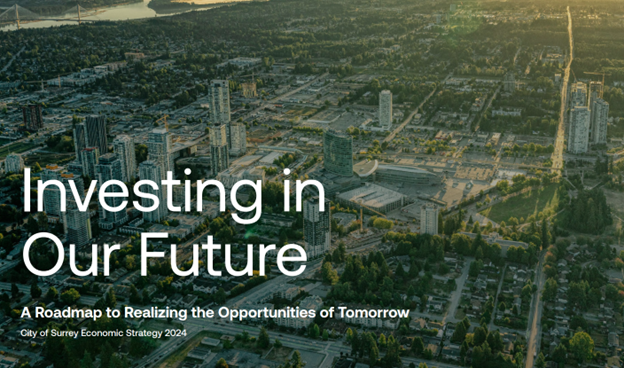
The Surrey Economic Strategy, Investing in Our Future: A Roadmap to Realizing the Opportunities of Tomorrow, established a long-term economic roadmap for one of Canada's fastest-growing cities and received strong external praise. Its priorities were subsequently incorporated into analysis and advocacy by Surrey's business community, including the Surrey Board of Trade.